
Liberty to the Captive
When Law, God and Duty are used to trap the wounded

For a long time, if you had asked me whether I was abused as a child, I would have said no.
My home life was warm and stable; I had parents and grandparents who loved me. I had food, safety, belonging.
School and The Law of Men
School was different. What happened to me at school wasn’t called “abuse.” It was called “bullying,” and treated like a largely harmless, temporary situation. Manageable, even—if I would just try harder to make friends. if I would just smile more. If I would just “not let them upset me.”
I begged not to go. I was told “You have to go to school. It’s the law.”
In sixth grade, my teachers became bullies, too. I had “block” class, three and a half hours each day, with a single teacher. No one in the room had assigned seats, except for me and one other boy. He and I had assigned seats, front row center, and we were not allowed to speak. We were not allowed to raise our hands. We were required to sit in silence while Mrs. Foster berated us for “thinking we were better than the other kids because we were smart.” While she told our classmates that “Smart kids always think they should get all of the good things, but sometimes other people get to have good things, too!”
It did not improve my relationships with my classmates.
I refused to do my school work at all; I made my first-ever C.
I stopped begging, and simply refused to go to school.
My mother could not understand; school, for her, had been a refuge from an unstable home life. She took away my housekey and locked me out of the house every morning, refusing to let me back in until I had gone to school.
So, my body found a loophole.
I vomited.
If you’re puking, no one can say you aren’t sick. On mornings when I just could not face school, I puked at the bus stop, and was sent home. It wrecked my digestive tract; by seventh grade I was spending as much time at doctors’ offices, drinking barium milkshakes and collecting Tagamet prescriptions, as I was spending in class. The doctors could not find any physical problem with me.
I did not dare tell the truth. The truth had already been overruled.
In eighth grade, I was cut from the herd by a gang and assaulted in the hallway between classes. Fed up and finished, I fought back. I landed a solid punch square in the chest of my assailant, who looked quite stunned in the moment before a teacher finally showed up.
The school suspended me for fighting.
Three days off school, free of charge? I’d have taken it. Instead, my parents and my war veteran, pillar-of-the-community grandfather all showed up in the principal’s office the next day to insist that the record be expunged and I be sent back to class—or they would report the assault to the police.
I got half a day off, and back I went.
By then, I had learned something.
Institutions do not yield to distress. Fighting back brings punishment. The system was more powerful than I was.
You go back.
Marriage and the Law of God
At twenty years old, I married my high school sweetheart. We had dated for four years. He was handsome, smart, funny, and different from my previous boyfriends—the ones who pushed my boundaries or showed their tempers.
Six months after we married, he showed me his temper for the first time.
But I had already been trained.
You get married, you stay married. God hates divorce. What God has joined, let no one separate. The rule was clear. The law reinforced it. The Church sanctified it. Duty wrapped it in holiness.
Like school, marriage was compulsory. Like school, resistance was a rebellion that would be quashed.
So, when what started as screaming fits became systematic degradation, I did what I had been formed to do.
I stayed.
God, duty and the law had laid a trap for me, and I had walked right in, wearing the golden shackle on the ring finger of my left hand.
As a child, when I could not escape, my body revolted. As an adult, my body sounded alarms.
I had always had panic attacks, though I did not know what to call them. In my marriage, they intensified. I would wake in the night with my heart pounding, sweating ice, terrified—not only of the fear itself, but of waking him and being required to explain something I could not safely name.
The lesson had been learned early: there is no acceptable explanation. There is no exit. Endure.
Liberty to the Captive
Here is what I know now.
It is possible to use the law in ways that protect the vulnerable. It is possible to invoke God in ways that liberate, rather than crush. It is possible to speak of duty in ways that honor covenant, rather than weaponize it.
When law, God, and duty are invoked to trap someone in ongoing harm, they no longer reflect Christ.
Christ did not trap people in suffering to preserve institutional order.
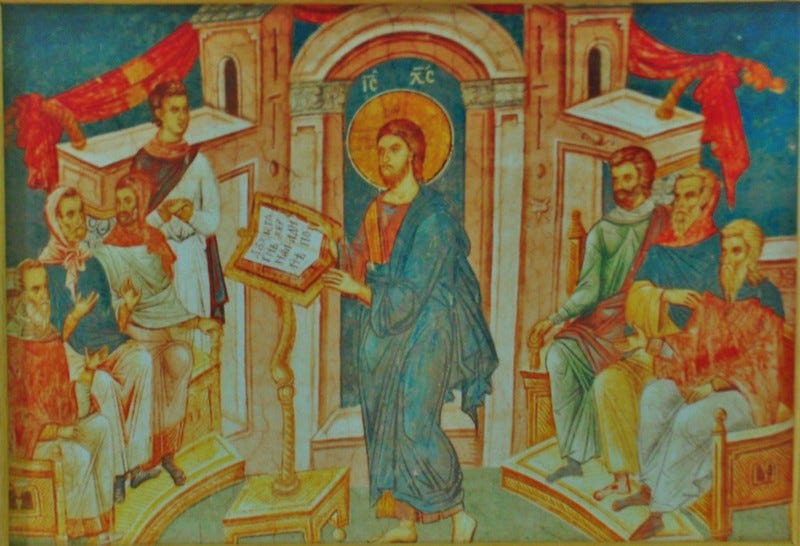
He did not send the wounded back into what was wounding them.
He did not confuse endurance with holiness.
It is wrong to compel a child to remain where she is unsafe. It is wrong to compel and adult to remain where covenant has become coercive control.
Especially when the authorities insisting on obedience are not the ones absorbing the harm.
When Jesus stood in the synagogue in Nazareth and announced his mission, he did not say he had come to preserve institutions. He did not say he had come to reinforce every binding that bore God’s name.
He said he had come “to proclaim liberty to the captives… to set at liberty those who are oppressed.”
Not to explain to the captives why captivity builds character.
Not to remind the oppressed of their duty to endure.
Not to send them back quietly so the system could remain undisturbed.
Liberty.
If our invocation of law, or covenant, or God Himself results in captivity for the vulnerable, we are not echoing Christ. We are contradicting him.
The One I follow announces freedom.
And any theology that traps the wounded in harm cannot claim to speak in His name.
Yessss! Preach it sistah!